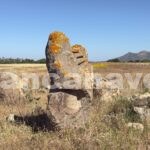

The territory of Villaperuccio, in southern Sardinia, preserves one of the island’s most imposing megalithic treasures, central to understanding the history and mystery of the Sardinian megalith: the Luxia Arrabiosa menhir, also known as the Terrazzu menhir. This monolith, which rises majestically in the Sulcis countryside, represents an extraordinary testimony to pre-Nuragic civilization, connecting indissolubly with the nearby Montessu necropolis, one of the most important in all of Sardinia.
The presence of these ancient monuments transforms this corner of Sardinia into a true open-air museum, where millennial history and landscape merge into a unique and evocative experience.

🏛️ Architectural Characteristics of the Menhir
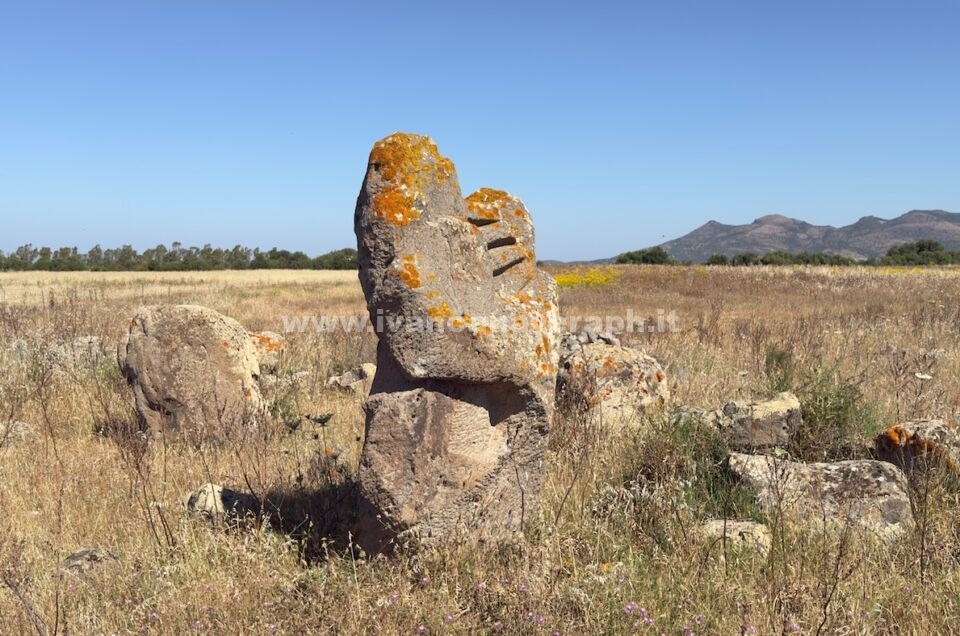
The Luxia Arrabiosa menhir, located in the Terrazzu area near Villaperuccio, represents the most imposing specimen in the territory, reaching a height of over 5 meters, although it has been mutilated by lightning in the upper part. The monolith has a trapezoidal cross-section with rounded corners, with the main face flat facing southeast and the opposite one semi-convex.
Its original imposingness must have been even greater before natural damage. According to some sources, the original height approached six meters, making it one of the tallest menhirs in southern Sardinia. The choice of orientation towards the southeast is not random, but probably linked to astronomical and religious meanings still being studied today.
The material used for its construction is local stone, probably trachyte, extracted from local quarries and worked with refined techniques for the era, testifying to the high technical competence of pre-Nuragic populations.
🔍 Construction Details
The trapezoidal shape of the menhir is not an isolated case, but reflects precise aesthetic and symbolic canons of Sardinian megalithic cultures. The main surface, facing dawn, could have had ritual functions related to solar worship, a practice widespread in pre-Nuragic civilizations. The absence of visible incisions on the surface, unlike other Sardinian menhirs, leaves room for different interpretations of its specific use.
🗺️ The Territorial Context: A Sacred Landscape
The territory of Villaperuccio has at least fifteen menhirs in hard stone variously located, in addition to numerous testimonies of human presence in the Neolithic. This extraordinary concentration of megalithic monuments suggests that the area was considered sacred by ancient populations, a place of particular spiritual and social importance.
The position of the Luxia Arrabiosa menhir, located not far from Villaperuccio, in an agricultural area near the confluence of two rivers, is not random. Watercourses were considered sacred elements by pre-Nuragic populations, and their confluence represented a point of particular telluric energy.
The distribution of menhirs in the territory follows precise patterns, often aligned according to significant astronomical directions or placed in visual relationship with each other, creating a true “ritual landscape” that embraced vast areas of Sulcis.
🌄 The Terrazzu Valley
The most important group of menhirs is located in the Terrazzu valley, where the largest and most imposing menhir, called “Luxia Arrabiosa,” is located. This valley, protected by surrounding hills, offered ideal conditions for prehistoric settlements, with fertile land, abundant water, and strategic position for territorial control.
📅 Historical Origins and Dating
The origins of the Luxia Arrabiosa menhir are lost in the mists of time, dating back in all probability to the period between the 4th and 3rd millennium BC, during the final Neolithic. This period was characterized by profound social and cultural changes in Sardinia, with the development of increasingly complex and organized communities.
The Ozieri culture, which flourished in this period, is known for the construction of megalithic monuments and sophisticated ceramic production. It is very likely that the menhir was erected by these populations, who already demonstrated notable engineering capabilities and deep spirituality linked to the cult of the dead and natural forces.
The chronology of the monument fits perfectly into the period of maximum development of Sardinian pre-Nuragic cultures, when the island was crossed by intense commercial and cultural exchanges with the western Mediterranean.
🏺 Cultural Connections
The menhir fits into a broader cultural context that embraces the entire western Mediterranean, where similar monuments were erected by megalithic populations of southern France, Corsica, and the Balearics. These connections testify to the existence of exchange networks and cultural influences that united the islands and coasts of the western Mediterranean in a homogeneous cultural area.
⚱️ The Montessu Necropolis: An Indissoluble Bond
The Montessu necropolis represents one of the most significant pre-Nuragic testimonies of the island, used for a millennium and a half from the final Neolithic (3200-2800 BC) to the early Bronze Age (1800-1600 BC). Located on the southern slopes of the Sa Pranedda hill, a few kilometers north of Villaperuccio, it has about forty domus de janas and is considered one of the largest and most important in all of Sardinia.
The geographical and chronological proximity between the Luxia Arrabiosa menhir and the Montessu necropolis is not random, but highlights a deep functional and symbolic connection. Both sites are part of a complex ritual system that characterized the territory during the pre-Nuragic period.
The necropolis presents tombs with very varied floor plans, often of very different dimensions, among which stands out the “tomb of spirals,” decorated inside with wolf teeth in the antechamber, a taurine protome in the entrance wall of the cell, numerous spirals symbolizing the eyes or breasts of the mother goddess.
🔗 Complementary Functions
The menhir could serve as a reference point for rituals related to the cult of the dead, while the necropolis represented the physical place of burial and passage to the afterlife. This duality between the world of the living (represented by the menhir) and the world of the dead (represented by the domus de janas) was characteristic of pre-Nuragic religions.
🏛️ Ritual and Symbolic Meaning
The Luxia Arrabiosa menhir, like all megalithic monuments, probably had multiple functions that went beyond simple territorial demarcation. Its imposingness and position suggest a central role in community rituals, perhaps as a gathering point for religious ceremonies or as an astronomical marker for determining important dates in the agricultural calendar.
The orientation towards the southeast could be connected to the observation of sunrise at particular times of the year, such as solstices or equinoxes, crucial events for agricultural communities of the era. This calendar-astronomical function was typical of many European megalithic monuments.
The name “Luxia Arrabiosa” (literally “Angry Lucia”) could derive from subsequent folk legends, but preserves echoes of ancient traditions linked to the worship of light and female divinities, central elements in pre-Nuragic religions.
🌟 Astronomy and Religion
The relationship between astronomy and religion was fundamental in pre-Nuragic cultures. The menhir could serve as a “stone calendar,” allowing communities to synchronize agricultural activities with celestial cycles. This function was essential in a society based on agriculture and livestock.
🔬 Archaeological Excavations and Discoveries
The Montessu necropolis was excavated repeatedly from 1971 to 1990, by Enrico Atzeni and Remo Forresu. These excavations revealed an extraordinary wealth of finds that allowed the reconstruction of daily life and funerary practices of pre-Nuragic populations.
The ceramic finds, lithic tools, and ornamental objects found in the tombs confirmed the prolonged use of the site and cultural contacts with other Mediterranean areas. The presence of ceramics from the Ozieri culture, Abealzu-Filigosa, and Bell Beaker testifies to the continuity of use of the site through different cultural phases.
Recent studies have highlighted the importance of the site not only from an archaeological point of view, but also anthropological and social, revealing unprecedented aspects of the social organization of pre-Nuragic communities.
📊 The Finds and their Interpretation
The materials found include decorated ceramics, obsidian tools, metal ornamental objects, and marine shells. These finds testify to the existence of extensive commercial networks and a complex society, capable of specialized production and long-distance exchanges.
🚶♂️ Visiting the Site Today
The Luxia Arrabiosa menhir is located at via Santa Lucia 33, Terrazzu locality, in the municipality of Villaperuccio. The menhir is located on fenced land, freely accessible, next to a private residence. Despite its historical importance, the site does not currently enjoy adequate enhancement and appears in a state of relative abandonment.

👉 Per i miei viaggi scelgo sempre DiscoverCars per il noleggio auto.
È affidabile, veloce e con ottime tariffe.
👉 I always choose DiscoverCars for my trips.
Reliable, fast and with excellent rates.



The visit to the menhir can be easily combined with that to the Montessu necropolis, creating a complete archaeological itinerary that allows appreciation of the richness of the territory’s pre-Nuragic heritage. The necropolis is composed of over 40 tombs of various sizes and floor plans, though 35 are visitable, aligned along the rocky wall in a symmetrical manner.
To reach the site, it is advisable to use a satellite navigator and contact local authorities in advance for information on opening hours and visiting arrangements.


🗺️ Recommended Itinerary
An ideal itinerary should include a visit to the Luxia Arrabiosa menhir in the morning, when sunlight illuminates the main face of the monument, followed by a visit to the Montessu necropolis in the afternoon, concluding with a walk through the historic center of Villaperuccio.
👉 Per i miei viaggi mi affido sempre a Discoverycars per il noleggio auto. Se vuoi viaggiare senza pensieri, ti consiglio questa società: clicca sull’immagine e scopri di più!
👉 I always choose Discoverycars for my trips. If you want to travel safely and worry-free, I highly recommend them – just click the image to learn more!
👉 En mis viajes siempre confío en Discoverycars para alquilar el coche. Si quieres viajar con tranquilidad, te recomiendo esta compañía: haz clic en la imagen y descubre más.

❓ Frequently Asked Questions (FAQ)
1. What is the height of the Luxia Arrabiosa menhir?
The menhir currently reaches a height of over 5 meters, but it was originally taller before being damaged by lightning in the upper part.
2. When was the menhir built?
The menhir probably dates back to the period between the 4th and 3rd millennium BC, during the final Neolithic, coinciding with the development of the Ozieri culture.
3. What relationship exists between the menhir and the Montessu necropolis?
Both sites are part of a complex pre-Nuragic ritual system. The menhir could serve as a reference point for rituals related to the cult of the dead, while the necropolis represented the physical place of burials.
4. Is it possible to visit the menhir freely?
Yes, the menhir is located on freely accessible land, although it is advisable to check with local authorities for the most appropriate visiting arrangements.
5. How many menhirs are there in the territory of Villaperuccio?
The territory has at least fifteen menhirs in hard stone, distributed in various locations, making the area one of the richest in megalithic monuments in Sardinia.


You might also like