
Articolo tradotto in lingua inglese per leggere quello in italiano clicca QUI
🏛️ Introduction: A Hidden Treasure in the Mediterranean Scrubland
When I take the road that climbs towards the Burdaga necropolis in Asuni, I immediately realize I’m in a special place. We’re in the pulsating heart of Sardinia, where the upper Marmilla meets the Sarcidano, and here nature has painted a breathtaking picture. Moreover, the Mediterranean scrubland embraces these ancient tombs with an embrace that changes face with every season, but always remains magical.
The necropolis sits on spurs of trachytic rock that follow a serpentine pattern, creating a landscape that seems sculpted by divine hands. However, it was human hands, over 5000 years ago, that carved here 17 domus de janas that today constitute one of the most fascinating funerary complexes on the island. Therefore, every step among these tombs is a journey through time that always moves me.
🌿 The Landscape: A Natural Amphitheater of Wild Beauty
What makes Burdaga truly special is its landscape setting. The wide platforms of trachytic tuff alternate with scarps and slopes that overlook the valley below, creating breathtaking scenery. Indeed, when I visit this site in November, as I recently did, the Mediterranean scrubland explodes in a palette of intense greens, fragrant with myrtle, mastic tree and strawberry tree.
In winter the landscape becomes more intimate and collected, with rocks that shine after the rain and holm oak woods that protect the tombs like silent sentinels. However, even in summer this place maintains its charm, when the golden light of sunset paints the trachytic walls with warm shades and the essences of the scrubland release intoxicating fragrances. Therefore, each season offers different but equally intense emotions.

🗿 The Tombs: Funerary Architecture of Great Refinement
The 17 domus de janas of Burdaga are distributed in two distinct groups. Moreover, the first group, more substantial, counts 13 tombs arranged at different heights on the northern rocky ridge. The second group, composed of 4 hypogea, is located further south, organized according to a plan reminiscent of a natural amphitheater.
Despite the repetitiveness of the basic floor plan, each tomb possesses its own unique architectural personality. Therefore, while some domus present elliptical cells with curved “oven-shaped” ceilings (like tombs 14 and 15, probably the oldest), others show predominantly rectangular rooms with flat or slightly sloping ceilings. Indeed, archaeologists believe these differences testify to different construction phases of the necropolis.
🎨 Symbolic and Decorative Elements: Messages from the Afterlife
What strikes me most exploring Burdaga are the magical-religious signs that dot the antechambers. Moreover, I find fascinating the constant presence of circular or subcircular cavities on the walls and in the corners between ceiling and walls, testimonies of ancient rituals. In tombs 1, 5 and 9 I discover concavities on the floor and ceiling arranged in axis with each other on the sides of the porthole, elements also present in other sites like Su ‘Utturu de is Forros.
Domus 4 deserves special attention. Here the antechamber presents a bas-relief with a double horn-shaped motif carved with considerable accuracy, datable to the final phases of the Ozieri culture (second half of the 3rd millennium BC). However, other decorative elements with architectural function are the relief architraves around the entrance of domus 9 and 12. Therefore, every detail tells a story of beliefs and funerary rituals.

👉 Per i miei viaggi scelgo sempre DiscoverCars per il noleggio auto.
È affidabile, veloce e con ottime tariffe.
👉 I always choose DiscoverCars for my trips.
Reliable, fast and with excellent rates.


👥 The Ozieri Culture: The Architects of Eternity
The people who carved these tombs belonged to the Ozieri culture, also known as San Michele culture, which flourished in Sardinia between 3200 and 2800 BC. Moreover, this pre-Nuragic civilization represents one of the most important and sophisticated cultures of the Neolithic Mediterranean. They were peaceful and industrious populations, dedicated to agriculture and livestock, organized in small rural villages.
However, what distinguished them was their extraordinary artistic and architectural ability. Indeed, they produced finely decorated ceramics with geometric motifs, similar to those of the Cyclades and Crete, testimony to intense commercial and cultural exchanges. Therefore, the domus de janas were much more than simple tombs: they represented true houses for the afterlife, where the deceased could continue to live surrounded by loved ones.
🏺 Life and Death: The Conception of the Afterlife
Exploring the funerary cells of Burdaga, I better understand the conception these populations had of the afterlife. Moreover, in the more elaborate domus I find funerary beds carved in the rock, as in tomb 1 where two opposite resting places are separated by a relief partition. In domus 9 I discover a large raised alcove, while in tomb 5 a niche with unfinished walls opens.
All these elements confirm the existence of a precise conception of afterlife. Indeed, the deceased was buried in a tomb that symbolized their house, complete with different rooms just like the dwellings of the living. However, the antechambers were probably dedicated to magical-religious rituals, while the innermost cells housed the actual burials. Therefore, each space had a precise meaning in this complex system of beliefs.
🗺️ An Archaeological Itinerary in the Heart of Sardinia
The beauty of visiting Burdaga is that the surrounding territory offers a true concentration of prehistoric archaeology. Indeed, a few minutes by car I can reach other extraordinary testimonies of the past that greatly enrich the travel experience.
📍 Genna Salixi Necropolis
In Villa Sant’Antonio, about 15 minutes away, lies one of the most spectacular necropolises in Sardinia: Genna Salixi. Moreover, this necropolis counts 14 domus de janas considered among the most beautiful on the island for their particularly advanced architectural conception. Twelve of them open in horizontal series on a ridge of trachytic rock, while two are located opposite. Therefore, the monumental facades and the accuracy of the workmanship are breathtaking, especially that of tomb 3 with its upper curvilinear incision.

⚰️ Giants’ Tomb of Aiodda
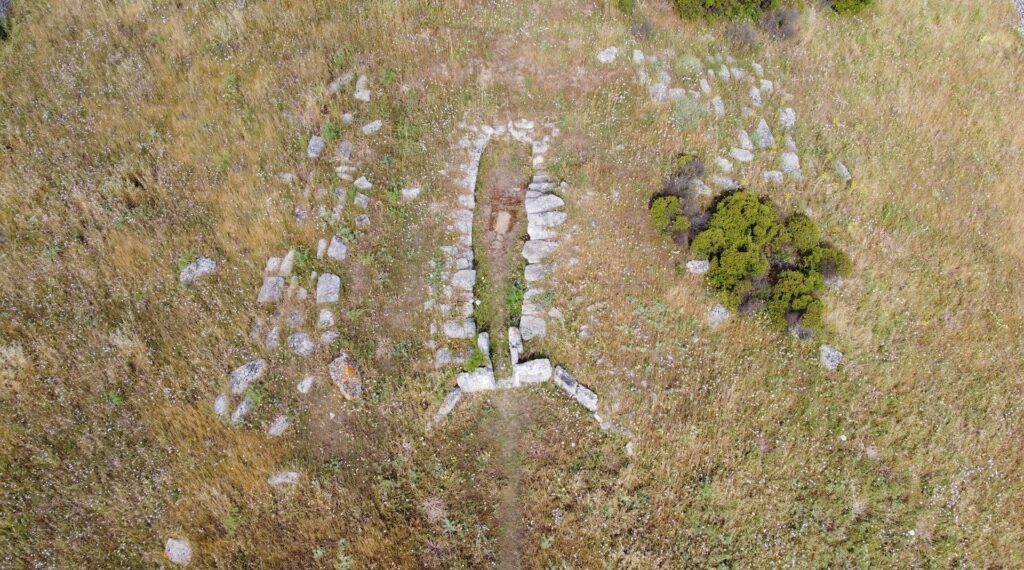
Continuing towards Nurallao, I reach the extraordinary Giants’ Tomb of Aiodda, located on the Pranu Is Ciaexius plateau. However, this megalithic burial from the Middle Bronze Age presents unique characteristics: the semicircular exedra with limestone orthostatic slabs, the arched stele and, above all, an anthropomorphic statue-menhir reused as an orthostat in the entrance corridor. Moreover, the 10-meter-long funerary cell with its “overturned boat” shape recalls the navetas of the Balearic Islands. Therefore, this monument testifies to the respectful reuse of older elements by Nuragic cultures.
🌄 The Four Seasons at Burdaga: When to Visit
Each season offers a different experience at Burdaga, and all have their particular charm. Indeed, in spring the Mediterranean scrubland explodes in spectacular flowering, with the scent of myrtle and broom that intoxicates. However, summer offers unforgettable sunsets, when the grazing light enhances the volumes of the trachytic rocks and the silvery green of the vegetation creates suggestive contrasts.
In autumn, when I visited in November, the landscape dresses in warm tones and the holm oak and cork oak woods create an intense green mantle. Moreover, the rains make the rocks shine and accentuate the chromatic contrasts. Winter brings a deep silence and an intimate atmosphere that makes the experience even more contemplative. Therefore, there really is no wrong season to visit this magical place.


Alcune delle Domus de Janas più note e importanti includono:
- Necropoli di Genna Salixi – Villa Sant’Antonio
- Necropoli di Sant’Andrea Priu – Bonorva
- Domus Ludurru – Budduso
- Necropoli di Montessu – Villperuccio
- Domus De Janas Prunittu – Sorradile
- Necropoli S’acqua Salida – Pimentel
- Parco Archeologico su Motti – Orroli
- Necropoli di Burdaga – Asuni
- Necropoli S’Acqua Salida – Pimentel
- Domus de Janas di Fossada – Escalaplano
- Necropoli di Is Loccis Santus – Carbonia
- Necropoli di Partulesi – Ittireddu
- Necropoli di Museddu – Cheremule
- Necropoli di Musellos – Ittir
Se ti piacciono queste immagini puoi acquistarle “cliccando QUI” oppure “QUI”
Some of the most famous and important Domus de Janas include:
- Necropolis of Genna Salixi – Villa Sant’Antonio
- Necropolis of Sant’Andrea Priu – Bonorva
- Domus Ludurru – Budduso
- Necropolis of Montessu – Villperuccio
- Domus de Janas Prunittu – Sorradile
- Necropolis of S’acqua Salida – Pimentel
- Archaeological Park of Su Motti – Orroli
- Necropolis of Burdaga – Asuni
- Necropolis of S’Acqua Salida – Pimentel
- Domus de Janas of Fossada – Escalaplano
- Necropolis of Is Loccis Santus – Carbonia
- Necropolis of Partulesi – Ittireddu
- Necropolis of Museddu – Cheremule
- Necropolis of Musellos – Ittiri
If you like these images, you can purchase them by clicking HEREor HERE“.
🧭 How to Get There and Practical Information
Access: The Burdaga necropolis is located on the north-eastern outskirts of Asuni, along the road of the same name. From the town center, following the signs for Burdaga locality, the site can be reached in a few minutes by car. Moreover, the tombs are easily identifiable on the rocky spurs visible from the road.
GPS Coordinates: 39.8933° N, 8.9433° E (approximate coordinates – verify on site)
Parking: It is possible to park along the road in the immediate vicinity of the site. However, it is advisable to pay attention in the winter months for any adverse weather conditions.
Accessibility: The site has a natural conformation with slopes and differences in height. Therefore, a minimum of agility is necessary to explore all the tombs, some of which are located on small rocky platforms at different heights.
❓ FAQ in English
1. How many domus de janas are there in Burdaga and when were they carved? The Burdaga necropolis includes 17 domus de janas distributed in two groups. They were carved during the late Neolithic period, between 3200 and 2800 BC, by the Ozieri culture. Some tombs, such as numbers 14 and 15, may belong to the earliest phases of the necropolis.
2. Is the site easily accessible for families with children? Access to the site requires a minimum level of agility since the tombs are located on rocky spurs at different heights. With older children and taking due precautions it is possible to visit it, paying attention to slopes and irregular surfaces.
3. What makes the Burdaga necropolis special compared to others? Burdaga stands out for its extraordinary landscape setting, with tombs arranged on trachytic platforms immersed in Mediterranean scrubland. Furthermore, it presents architectural and decorative elements of great interest, such as the horn-shaped motifs of domus 4 and the variety of floor plan solutions.
4. Is it possible to take photographs inside the tombs? Yes, photography for personal use is allowed. It is recommended not to use flash to preserve any traces of pigments and not to touch the walls. For professional or commercial use, authorization is required.
5. What other archaeological sites can I visit nearby? There are numerous sites of great interest in the surrounding area: the Genna Salixi necropolis in Villa Sant’Antonio, the Giants’ Tomb of Aiodda in Nurallao, and other domus de janas in the Asuni area such as the one at Su ‘Utturu de is Forros.


You might also like