
🪨 Where it is and what the Rock Altar represents
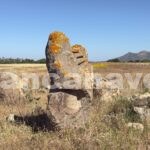
Just a few kilometers from Oschiri, nestled among hills and Mediterranean vegetation, lies the Ancient Rock Altar of Santo Stefano in Oschiri with carved niches and cup marks in granite. It is a massive granite outcrop, about ten meters long, carved with enigmatic symbols that still capture the imagination today. Triangular niches, circular hollows, geometric signs and crosses engraved on the surface make this a unique place, suspended between history and myth.
Standing right in front of the altar is the small church of Santo Stefano, built at the end of the 15th century and consecrated a few years later. With its simple single nave and inscriptions carved into the façade, it bears witness to the continuity of a sacred tradition that never truly ceased, transforming an ancient ritual space into a Christian place of devotion.
🌿 Signs on the stone: a language to be deciphered
The altar reveals two registers of carvings: on the lower part, about a dozen triangular and rectangular niches; on the upper section, more niches of different shapes, including one round cavity that stands out. Nearby, a group of hollows arranged in a circle seems to form a true “stone calendar”: twelve small cup marks around a larger central one, with a thirteenth aligned to the north.
On the left, a carved stone bench suggests rituals linked to offerings, or perhaps incubation practices, where people would sleep in a sacred place to receive visions or divine messages. Walking around the altar, crosses appear on the granite: signs of later Christian influence that merged with, rather than erased, the traces of much older spirituality.

🏛️ Domus de Janas, necropolis and church: a layered sacred landscape
The area surrounding the altar is just as captivating. Here you find several Domus de Janas, hypogean tombs carved into the rock during the Late Neolithic, between 3500 and 2700 BC. Some consist of small circular chambers with niches, clear evidence of a funerary cult that linked daily life with the world beyond.
Alongside these tombs are traces of the Nuragic age and megalithic structures, proof that the hill was a sacred landmark for millennia. Completing the picture is the medieval church of Santo Stefano, which not only Christianized the site but also preserved it across centuries, even housing a small Nuragic betyl now used as a stoup.
🥾 The trail and the experience of the visit
Reaching the site is surprisingly simple: from Oschiri, a short road leads to the entrance of the path. The trail itself is brief and easy, surrounded by Mediterranean shrubs and panoramic views that are worth the walk alone.
As you approach the altar, silence becomes part of the journey: the forest and rocks seem to absorb every sound, creating a sense of isolation that underlines the sacred nature of the place. Standing before the large carved granite outcrop, it feels as if time dissolves, bringing you into a world where religion, nature and mystery were deeply intertwined.
🧩 The mysteries of the Rock Altar
The true magic of the Rock Altar lies in its unanswered questions. No one knows exactly when it was carved or what its purpose was. Some believe it dates back to the Neolithic, while others suggest later times, perhaps even Byzantine.
The niches may have symbolized doorways between life and the afterlife, while the cup marks could represent a ritual calendar aligned with the stars or the seasons. The engraved crosses tell of Christian reuse, showing how sacredness was not erased but transformed. Visiting the site, you can’t help but feel that every sign on the stone whispers fragments of forgotten rites and timeless spirituality.
🔎 A dialogue with the ancient dead: the Domus de Janas
Beside the altar, the Domus de Janas add another essential layer to the site’s meaning. These are hypogean tombs carved into the granite, often with two small chambers and ritual niches inside. Some sources mention five or six, others as many as eight: proof that this hill was a central place for the communities that once lived here.
Walking near these tombs, you sense the continuity of the sacred. Here the living stayed connected with their ancestors, celebrated rites of passage and maintained a bond with the world of the dead. Visiting the necropolis feels like stepping into time itself, where ancient people left their mark and created a space of memory that still speaks to us.
📸 Tips for photography lovers
For photography enthusiasts, this site is pure magic. The light of early morning or late afternoon highlights the granite carvings, creating shadows that make the niches and hollows stand out. The details deserve close attention: engravings, the carved faces on the church, the tiny crosses hidden in the stone.
Bring a wide-angle lens for the altar and the landscape, but don’t forget to focus on the smaller details that tell the story of the place. The contrast between rough granite and lush vegetation creates evocative images where nature and history blend seamlessly.
Gallery:

👉 Per i miei viaggi scelgo sempre DiscoverCars per il noleggio auto.
È affidabile, veloce e con ottime tariffe.
👉 I always choose DiscoverCars for my trips.
Reliable, fast and with excellent rates.



Maps:
Alcune delle Domus de Janas più note e importanti includono:
- Necropoli di Genna Salixi – Villa Sant’Antonio
- Necropoli di Sant’Andrea Priu – Bonorva
- Domus Ludurru – Budduso
- Necropoli di Montessu – Villperuccio
- Domus De Janas Prunittu – Sorradile
- Necropoli S’acqua Salida – Pimentel
- Parco Archeologico su Motti – Orroli
- Necropoli di Burdaga – Asuni
- Necropoli S’Acqua Salida – Pimentel
- Domus de Janas di Fossada – Escalaplano
- Necropoli di Is Loccis Santus – Carbonia
- Necropoli di Partulesi – Ittireddu
- Necropoli di Museddu – Cheremule
- Necropoli di Musellos – Ittir
Se ti piacciono queste immagini puoi acquistarle “cliccando QUI” oppure “QUI”
Some of the most famous and important Domus de Janas include:
- Necropolis of Genna Salixi – Villa Sant’Antonio
- Necropolis of Sant’Andrea Priu – Bonorva
- Domus Ludurru – Budduso
- Necropolis of Montessu – Villperuccio
- Domus de Janas Prunittu – Sorradile
- Necropolis of S’acqua Salida – Pimentel
- Archaeological Park of Su Motti – Orroli
- Necropolis of Burdaga – Asuni
- Necropolis of S’Acqua Salida – Pimentel
- Domus de Janas of Fossada – Escalaplano
- Necropolis of Is Loccis Santus – Carbonia
- Necropolis of Partulesi – Ittireddu
- Necropolis of Museddu – Cheremule
- Necropolis of Musellos – Ittiri
If you like these images, you can purchase them by clicking HEREor HERE
❓ FAQ – Frequently asked questions
1. What is the dating of the Santo Stefano Rock Altar?
There is no precise dating. It may go back to the Late Neolithic, but later additions suggest use in Byzantine and Medieval times.
2. What was the purpose of the carvings on the stone?
They might have served for votive offerings, incubation rituals, or as symbolic representations of the passage between life and death.
3. Is the site easy to reach?
Yes, the trail is short and simple, starting just outside Oschiri. It is suitable for all visitors.
4. What are the Domus de Janas near the altar?
They are ancient hypogean tombs carved into the granite during the Late Neolithic, used for collective burials and rituals.
5. Can the site be visited with a guide?
Yes, local guides organize tours that enrich the visit with stories, curiosities and archaeological insights.
👉 Per i miei viaggi mi affido sempre a Discoverycars per il noleggio auto. Se vuoi viaggiare senza pensieri, ti consiglio questa società: clicca sull’immagine e scopri di più!
👉 I always choose Discoverycars for my trips. If you want to travel safely and worry-free, I highly recommend them – just click the image to learn more!
👉 En mis viajes siempre confío en Discoverycars para alquilar el coche. Si quieres viajar con tranquilidad, te recomiendo esta compañía: haz clic en la imagen y descubre más.



You might also like