
Giants’ Tomb of Paule Luturru: A Journey Among Menhirs and Mysteries in the Heart of Mandrolisai
🏛️ Introduction
When I traveled the road leading southwest from Samugheo, I couldn’t imagine that just two kilometers from the village one of the most enigmatic archaeological sites in central Sardinia awaited me. The Giants’ Tomb of Paule Luturru rises on a plateau overlooking the typical Mandrolisai landscape, surrounded by cultivated fields, dry stone walls and pinnatzos, the characteristic stone shepherds’ shelters. However, what makes this monument truly special is not only its imposing Middle Bronze Age funerary structure, but rather the mystery of the 46 statue-menhirs found in the surroundings, evidence of a sacred place frequented for millennia.
My visit, made during these winter days of January 2026, allowed me to photograph and study this archaeological complex in particular lighting conditions, with the low sun enhancing the pink trachyte of the orthostats. Furthermore, I was able to appreciate the strategic position of the site, which overlooks the valley carved by the Riu Massari, a tributary of the Tirso.
🗺️ Samugheo: The Textile Capital in Mandrolisai
Before reaching the tomb, it’s worth getting to know Samugheo, a village of about 2,500 inhabitants famous worldwide as the capital of Sardinian textile craftsmanship. Walking through the streets of the historic center, characterized by red trachyte houses with round-arched portals, you immediately perceive how deeply rooted the weaving tradition is in the local identity. Therefore, the MURATS (Unique Regional Museum of Sardinian Textile Art), inaugurated in 2002, preserves artifacts from all over the island, including blankets, pibiones carpets and rare 18th-century “tapinu ‘e mortu” (funeral textiles).
Samugheo textile craftsmanship has been passed down through generations using ancient techniques such as pibiones weaving, which creates particularly elaborate raised patterns. Despite modernity, many families keep this art alive using wooden looms and natural yarns such as wool, cotton and linen. Moreover, every year the Tessingiu event celebrates the excellence of Sardinian craftsmanship with almost sixty years of history behind it.
⛰️ The Archaeological Territory of Mandrolisai
The Mandrolisai, a historical region of central Sardinia, is extraordinarily rich in archaeological evidence ranging from the Neolithic to the Byzantine age. The territory of Samugheo, in particular, preserves domus de janas, single-tower nuraghes such as Perda Arrubia, Taccu and Pirarba, as well as important Eneolithic sites. During the middle Copper Age (2600-2400 BC), this area took on a crucial role, as demonstrated by the findings of statue-menhirs from the localities of Cucu de Lai, with over 300 fragments, and naturally Paule Luturru.
A short distance from Paule Luturru, I recommend visiting two exceptional sites that tell the story of the archaeological richness of this area. First, the megalithic alignment of Biru ‘e Concas, defined as the “Sardinian Stonehenge”, presents menhirs arranged according to astronomical orientations still under study. Subsequently, the Menhir of Monte Corru Tundu offers an excellent example of pre-Nuragic monumentalism in the Barbagia landscape.
🏺 The Giants’ Tomb: Architecture and Chronology
Approaching the monument, I’m struck by the perfect preservation of some architectural elements. The tomb features a funerary corridor 10 meters long and 1.20 meters wide, made with a double row of vertical slabs (orthostats) and equipped with a terminal apse. The semicircular exedra, probably facing south-southeast, consists of four blocks per side in local pink trachyte, finely worked especially those near the entrance. At the center of the exedra opens the monumental access, characterized by a stone threshold followed by a step with a recess, presumably intended to house a closing door.

The corridor floor was originally lined with small slabs, some of which remain visible in situ. The monumental paved body leans against the corridor, well preserved on the north side but compromised by agricultural work on the south side. This paving probably had the function of delimiting and enhancing the entire funerary complex. The archaeological dating places the tomb in the Middle Bronze Age (1600-1300 BC), the period of maximum flowering of the Nuragic civilization in Sardinia.
🗿 The Mystery of the 46 Statue-Menhirs
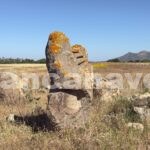
What makes Paule Luturru truly unique is the extraordinary discovery of 46 fragments of statue-menhirs reused as building material in the surrounding dry stone walls, in the exedra and even inside the tomb itself. This phenomenon is not accidental: evidently, the Nuragic builders erected the funerary monument on an area already considered sacred in previous eras. The statue-menhirs, dating back to the Copper Age (3000-2500 BC), had been voluntarily shattered and reused, in a process of “cancellation” of a now superseded religious world.
During the first excavations, about twenty statues characterized by enigmatic relief representations on the front face were identified. These present developed facial patterns with long noses and “eyebrows” that outline almost the entire ogival profile, an inverted “U” motif under the nose, and an elliptical central frieze bearing herringbone or lattice incisions. In addition, miniaturistic menhirs with reduced dimensions, probably not exceeding 80 cm in height, were recovered. Some of these statues are now preserved in the Museum of Prehistoric Statuary in Laconi, together with specimens from Villa Sant’Antonio and Allai.
🔍 Cultic Continuity and Settlement
The archaeological area of Paule Luturru includes not only the giants’ tomb but also the remains of a single-tower nuraghe and a Nuragic village, located about 300 meters in a west-northwest position, currently ruined and covered by vegetation. This proximity testifies to the importance of the area during the Bronze Age. Furthermore, the discovery of obsidian arrowheads near the nearby Pirarba nuraghe (about 1 km southwest) confirms the presence of Neo-Eneolithic settlements in the area.
In the immediate vicinity is also preserved a short section of paved road of difficult dating, probably part of an ancient communication route. Indeed, along the ignimbritic ridge that dominates the Riu Massari valley, several single-tower nuraghes are arranged in an east-west direction, from the Mura Maere nuraghe to Pirarba up to Paule Luturru, evidently placed to control a road route that ran along the underlying river. This route probably traced an even older path, used as early as the Neolithic and Eneolithic ages.
🌄 Sa Paule: The Sacred Pool
One of the most evocative elements of the site is represented by Sa Paule, the water pool that gave its name to the entire locality. The people of Samugheo know this spring well, which flows near the tomb creating a small marshy area. Water has always played a fundamental role in the prehistoric and Nuragic cults of Sardinia, so it’s not surprising that such an important burial place is found in relation to a natural source.
Observing the landscape during my visit, I noticed how this natural plateau offers a privileged view of the surrounding territory. Therefore, the choice of the place was not accidental but probably responded to topographic, religious and strategic criteria. The panorama sweeps over cultivated fields, pastures with flocks and the characteristic pinnatzos, creating a suspended atmosphere between past and present that makes the visit experience even more engaging.
🧭 How to Get There and Practical Information
How to get there: From Oristano proceed northeast on the SS388 to Ghilarza, then continue on the SP38 towards Samugheo (about 40 km from the provincial capital). From the center of Samugheo, follow the signs for the Paule Luturru locality, traveling about 2 km in a southwest direction. The site is accessible by car following local signage.
Parking: Cars can park directly near the entrance to the archaeological area. Alternatively, there is a parking area at Sa Paule about 200 meters away. For buses and large vehicles, it is preferable to use a clearing located about 700 meters from the site.
Access and tickets: The site is freely accessible, free and can be visited independently. No ticketing system is provided nor are organized guided tours available.
Hours: Accessible at any time of day throughout the year.
Accessibility: The site is located along the roadside and is accessible to all. However, the terrain may be uneven, so appropriate footwear is recommended.
Visit regulations: Photography for personal use is allowed. The use of drones is subject to current regulations and may require authorization from the Superintendency of Archaeology, Fine Arts and Landscape. The use of photographic tripods is generally permitted for non-commercial documentary purposes. Maximum respect for the site is recommended: do not remove stones, do not climb on the structures, do not leave waste.
🏛️ Conclusion
The Giants’ Tomb of Paule Luturru represents much more than a simple Middle Bronze Age funerary monument. It embodies the cultic continuity of a sacred place frequented for millennia, from the Neolithic to the Nuragic age. The 46 statue-menhirs reused in the construction tell the story of the will to connect the new Nuragic world with ancestral beliefs, transforming sacred stones of the past into foundations for the future. During my visit I was able to touch this stratification of meanings firsthand, photographing architectural details and immersing myself in a landscape that preserves its aura of mystery and spirituality intact.
Le tombe dei giganti, tra i monumenti più importanti della Sardegna, risalgono a circa 3.000 anni fa e si trovano in diverse aree dell’isola. Per saperne di più, puoi leggere un articolo qui. Ecco un elenco di alcune di queste tombe:
- – Tomba dei giganti di Lu Brandali, Santa Teresa Gallura (SS)
- – Tomba dei giganti di Iloi, Sedilo (OR)
- – Tomba dei giganti Is Lapideddas, Gonnosno (OR)
- – Tomba dei giganti di Aiodda, Nurallao (SU)
- – Tomba dei giganti di Barrancu Mannu, Santadi (SU)
- – Tomba dei giganti di Bau e Tuvulu, Ulassai (NU)
- – Tomba dei giganti di Biristeddi, Dorgali (NU)
- – Tomba dei giganti di Bruncu Espis, Arbus (SU)
- – Tombe dei giganti di Goronna, Paulilatino (OR)
- – Tomba dei giganti di Imbertighe, Borore (NU)
- – Tomba dei giganti di Is Concias, Quartucciu (CA)
- – Tomba dei giganti di Laccaneddu, Villanova Monteleone (SS)
- – Tomba dei giganti di Lassia, Birori (NU)
- – Tomba dei giganti di Coddu Ecchju, Arzachena (SS)
- – Tomba dei giganti di Li Lolghi, Arzachena (SS)
- – Tomba dei Giganti Su Niu de Su Crobu, Sant’Antioco (SU)
- – Tomba dei giganti di Madau, Fonni (NU)
- – Tomba dei giganti di Muraguada, Bauladu (OR)
- – Tomba dei giganti di Oratanda, Cuglieri (OR)
- – Tomba dei giganti di Oridda, Sennori (SS)
- – Tomba dei giganti di Osono, Triei (NU)
- – Tomba dei giganti di Palatu, Birori (NU)
- – Tomba dei giganti di Pascaredda, Calangianus (SS)
- – Tomba dei giganti di Sa Dom’e s’Orcu, Dolianova (SU)
- – Tomba dei giganti di Sa Domu ‘e S’Orcu, Siddi (SU)
- – Tomba dei Giganti di S’Ena e Thomes, Dorgali (NU)
- – Tomba dei Giganti di Sa Farch’e s’Artare, Seneghe (OR)
- – Tomba dei Giganti di Sa Perda ‘e S’Altare, Birori (NU)
- – Tomba dei Giganti di San Cosimo, Gonnosfanadiga (SU)
- – Tomba dei Giganti di Santu Bainzu, Borore (NU)
- – Tomba dei Giganti di Sas Presones, Cuglieri (OR)
- – Tomba dei Giganti di Su cuaddu ‘e Nixias, Lunamatrona (SU)
- – Tomba dei Giganti di Su Mont’e s’Abe, Olbia (SS)
- – Tombe dei Giganti di Sa Mandara, Guasila (SU)
- – Tombe dei Giganti di Monte Prano, Villaperuccio (SU)
- – Tomba dei Giganti di Paule Luturru, Samugheo (OR)
- – Tomba Megalitica di Pranu Ciara, Suelli (CA)
- – Tomba dei Giganti Perda Cossu, Norbello (OR)
- – Tomba dei Giganti Cuccuru Mannu, Riola Sardo (OR)
- – Tomba dei Giganti Sa Sedda e sa Caudela, Collinas (SU)
Se ti piacciono queste immagini, puoi acquistarle cliccando QUI o QUI.
👉 Per i miei viaggi scelgo sempre DiscoverCars per il noleggio auto.
È affidabile, veloce e con ottime tariffe.
👉 I always choose DiscoverCars for my trips.
Reliable, fast and with excellent rates.



❓ FAQ in English
1. What is the construction period of the Giants’ Tomb of Paule Luturru? The tomb was built during the Middle Bronze Age, between 1600 and 1300 BC, on an area already considered sacred in previous eras, as demonstrated by the Copper Age statue-menhirs reused in the structure.
2. What are the statue-menhirs found at Paule Luturru? They are anthropomorphic megalithic monuments dating back to the Copper Age (3000-2500 BC), characterized by relief representations with facial patterns, inverted U motifs and decorative friezes. 46 fragments were recovered and reused in the dry stone walls and in the tomb itself.
3. Is the site accessible and free? Yes, the Giants’ Tomb of Paule Luturru is freely accessible and free of charge. It is located along the road about 2 km from Samugheo in a south-west direction. No tickets are required and there are no closing times.
4. What to see near Paule Luturru? Nearby are the remains of a monotower nuraghe and a Nuragic village. In Samugheo, the MURATS, Museum of Sardinian Textile Art, is worth a visit. In the surrounding area you can explore other sites such as the Perda Arrubia nuraghe and the domus de janas.
5. What is the meaning of “Paule Luturru”? The name derives from “Sa Paule”, the water pool (swamp) located near the tomb and which gave its name to the entire area. Water was considered sacred and represented a fundamental element in prehistoric cults.