
Photo © Ivan Canavera – All rights reserved. All images in this article were taken personally by me, Ivan Canavera, during numerous trips throughout Sardinia. In this article I will tell you about the Giants’ Tombs in Sardinia — their history and the most beautiful ones to visit.
🌿 Introduction
In this guide you will find everything you need to know: history, architecture, symbolism, the most beautiful tombs to visit and some facts that will leave you speechless. Whether you are a curious traveller or a passionate enthusiast of Nuragic archaeology, this article is made for you.

Giants’ Tomb of Su Niu de Su Crobu — Nuragic funerary monument in trachyte (13th–15th century BC), with a 10-metre chamber and wide semicircular entrance
🏛️ Historical Context: Who Were the Builders?
The Nuragic civilisation flourished in Sardinia between approximately 1800 and 500 BC, during the Bronze and Iron Ages. It is one of the most complex and fascinating prehistoric cultures of the entire Mediterranean, yet it left no written records — a silence that still captivates scholars around the world today.
Furthermore, the Nuragic people were extraordinary builders: they erected thousands of truncated-cone stone towers called nuraghi, created sacred wells with surprising engineering techniques and, above all, built the Giants’ Tombs — collective funerary monuments that still dominate the Sardinian landscape today. Despite centuries and the elements, many of these structures stand with a solidity that takes your breath away.
🪨 What Are the Giants’ Tombs?
The name “Giants’ Tombs” was born from popular imagination: Sardinian shepherds, finding these enormous megalithic structures, attributed them to supernatural beings — giants. In the Sardinian language they are called tumbas de sos mannos, meaning “tombs of the great ones”. Archaeologists, however, adopted this romantic name, which perfectly captures the visual impact you feel when you see one for the first time.
These are collective burial sites, presumably used between the Early Bronze Age and the Final Bronze Age, that is between 1800 and 1100 BC approximately. The remains of numerous individuals were laid here, often with funerary objects and votive offerings, in a ritual that therefore held strong communal as well as spiritual value.
🏗️ Architecture: A Structure Built for Eternity
As you approach a well-preserved Giants’ Tomb, the first thing that strikes you is the scale. We are talking about funerary chambers up to 30 metres long and 3 metres high, built with enormous stone blocks either set vertically into the ground (orthostats) or arranged in horizontal courses.
The structure follows a precise and recognisable layout:
- The funerary corridor (or gallery): the central, long and narrow section where the deceased were laid to rest. Originally covered by horizontal slabs, many of which are still visible today.
- The semicircular exedra: the great stone embrace that frames the façade of the monument. It is the most scenic part, the one that greets you from the front.
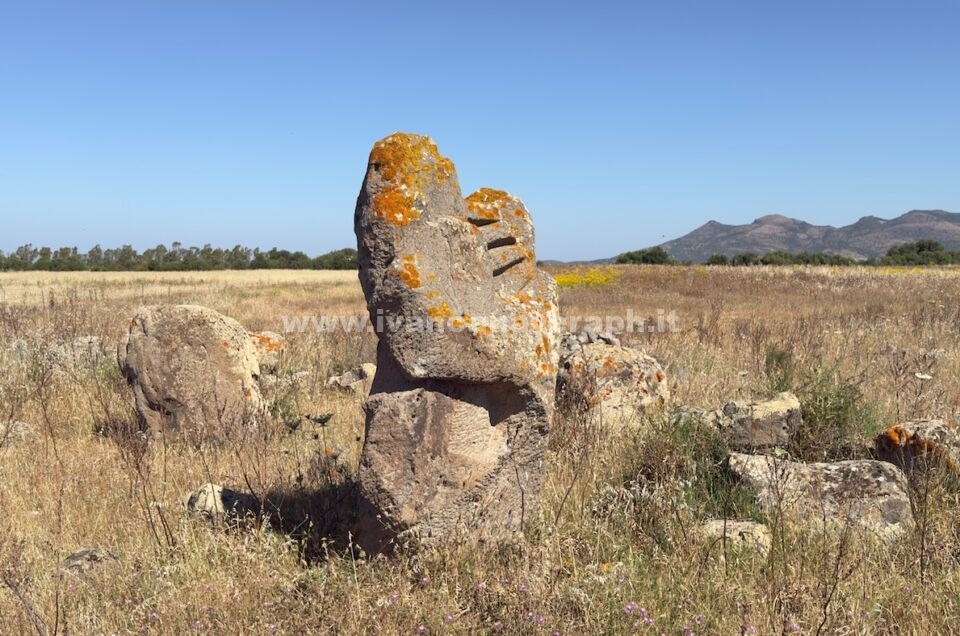
- The arched stele: in the oldest tombs and many of the most important ones, at the centre of the exedra stands a large vertical slab shaped into an arch, up to four metres tall, with a small symbolic opening at its base.
- The tumulus: originally the entire structure was covered by a mound of earth and stone, giving the tomb the shape of an upturned boat or an elongated silhouette visible across the landscape.
🐂 The Shape: Bull’s Head, Female Womb or Bow and Arrow?
This is probably the most fascinating question anyone approaches when coming close to these monuments. Seen from above, a Giants’ Tomb has a very distinctive shape: a long elongated body with a semicircular head at one end. And this is where the debate — still open among scholars and enthusiasts — begins.
🐃 The Taurine Interpretation
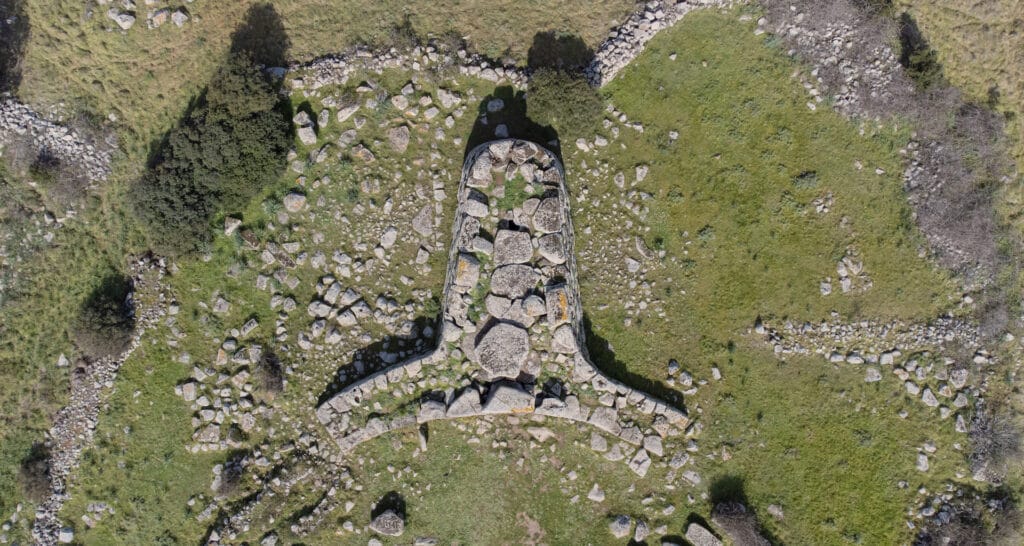
The most academically accepted theory is that of the taurine protome, meaning the shape evokes the head of a bull seen from the front. The semicircular exedra would represent the horns, while the corridor would be the elongated muzzle of the animal. The bull was a symbol of strength, fertility and power in Bronze Age Mediterranean cultures, so it is no surprise that the Nuragic people chose to evoke this image in their sacred burial places. From my personal point of view, the tomb that best embodies this shape is the Giants’ Tomb of Sa Domu ‘e S’Orcu in Siddi (SU). Directions here
👉 Per i miei viaggi scelgo sempre DiscoverCars per il noleggio auto.
È affidabile, veloce e con ottime tariffe.
👉 I always choose DiscoverCars for my trips.
Reliable, fast and with excellent rates.


🌸 The Womb of Mother Earth
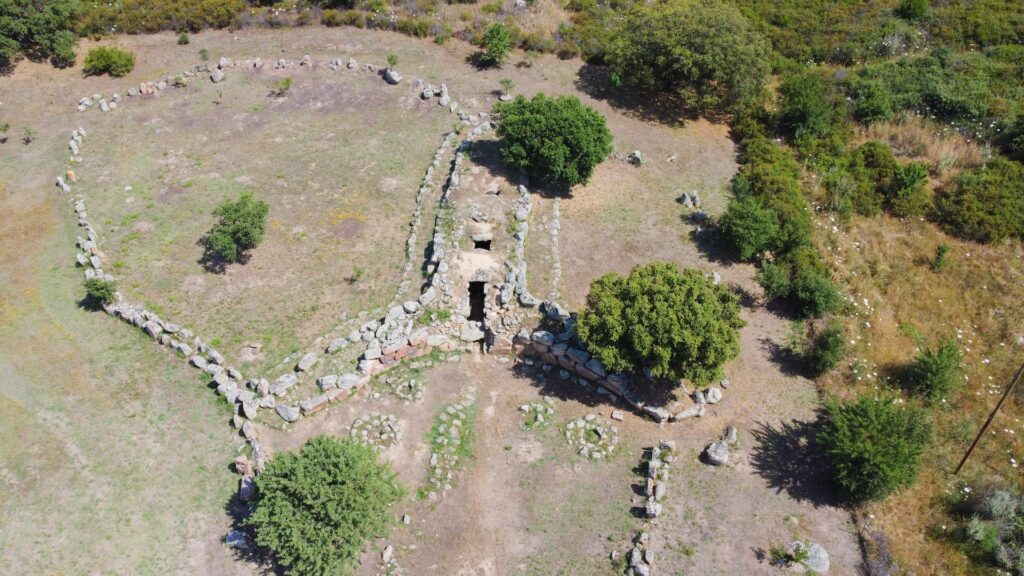
Another interpretation — fascinating and evocative, though less documented in official academic sources — sees in the tomb the representation of a female body. The exedra would be a woman’s open legs, and the entrance to the funerary chamber, that small opening at the centre of the stele, would symbolise birth: the deceased enters the womb of the earth to be reborn in the afterlife. This reading fits within the broader cult of the Mother Goddess, widely diffused in the Neolithic and surviving in various forms into the Bronze Age. However, it must be stressed that this is a symbolic hypothesis, not a documented certainty. The tomb that most reminds me of this shape is the Giants’ Tomb of San Cosimo in Gonnosfanadiga (SU). Directions here
🏹 The Bow and Arrow
There is a third interpretation, far less accepted by the scientific community, that reads in the shape of the tomb the silhouette of a bow with an arrow already nocked, ready to fly into the sky. According to this vision, the corridor is the arrow and the exedra the taut bow. Despite its limited diffusion among archaeologists, it is nonetheless interesting as an example of how much these monuments have stimulated imagination and the search for meaning over the centuries. The tomb that perhaps most recalls this shape is the Giants’ Tomb of Madau in Fonni. Directions here

In conclusion, the shape you observe in the Giants’ Tombs tells a great deal about a civilisation that thought big and built its sacred places with a care and intention that was anything but casual.
🔨 Architectural Types: An Evolution Over Time
Over the centuries, the Giants’ Tomb maintained its basic layout but was progressively enriched with new building techniques. Archaeologists distinguish mainly three evolutionary types:
Dolmenic Type — the oldest, characterised by the arched stele at the centre of the exedra. The stele can be monolithic or composed of two elements (bilithic). Magnificent examples are S’Ena e Thomes in Dorgali and Coddu Ecchju in Arzachena.
Coursed Masonry with Exedra Type — does not feature a stele but horizontal coursed masonry with roughly squared boulders. The exedra is nonetheless present and well defined.
Isodomic Type — the most recent and technically refined, borrowing construction techniques from the nuraghi and sacred wells, with a precision in stone-working that is truly remarkable.
🌟 The Most Beautiful Giants’ Tombs I Have Photographed
I have travelled across Sardinia in every season — under the scorching August sun and in the rain of recent winter days. Here, therefore, are the tombs that have moved me most, those that still fill me with wonder every time I revisit them through my photographs.
⭐ Coddu Ecchju – Arzachena (SS)
Located in the Capichera area, about 6 km from Arzachena, this is one of the most important and photographically spectacular monuments on the island. Its arched stele is the tallest known in Sardinia: 4.04 metres of granite carved with a precision that still defies explanation. Built in two phases — first the gallery between the 21st and 19th centuries BC, then the exedra and stele between the 18th and 17th centuries BC — it probably received the deceased from the nearby Nuragic village of La Prisgiona. Furthermore, the surrounding landscape of Mediterranean scrubland and Gallura vineyards makes the visit even more evocative. Link to the dedicated article
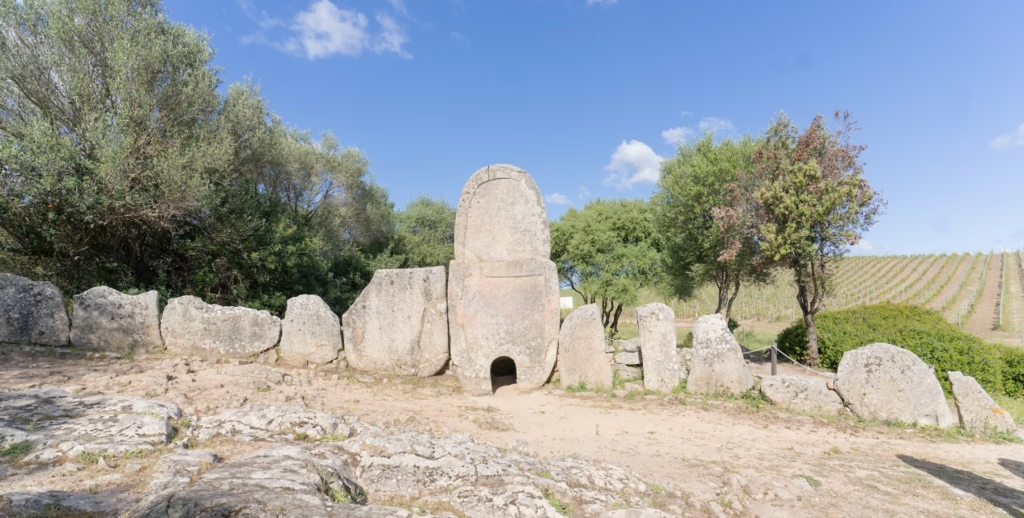
⭐ S’Ena e Thomes – Dorgali (NU)
In the valley of the Rio Isalle, surrounded by wild nature and reachable after a pleasant kilometre on an easy path (mind the gate: close it behind you so the sheep don’t escape!), this tomb is a masterpiece of the Early Bronze Age, dateable between 1800 and 1600 BC. The granite stele, 3.65 metres tall, weighs approximately 7 tonnes and features a relief frame and a symbolic portal at its base. Despite being oriented towards the south — unlike many other Nuragic tombs that face south-east — it retains its solemn atmosphere entirely intact. Link to the dedicated article

⭐ San Cosimo – Gonnosfanadiga (SU)
Considered the most extensive Giants’ Tomb known in Sardinia, the tomb of San Cosimo lies in the Medio Campidano territory. Therefore, if you want a concrete idea of what it meant to build on a monumental scale in the Bronze Age, this is the right place. Its size truly leaves you speechless. Link to the dedicated article

⭐ Sa Domu ‘e S’Orcu – Siddi (SU)
Set at roughly 260 metres above sea level on the Giara di Siddi plateau, this tomb bears a name that already evokes ancient worlds: “House of the Ogre”. The name reflects the popular fear of these mysterious monuments, yet today it is one of the most visited sites in the Campidano. So if you find yourself in the area, do not miss it under any circumstances.
Every time I return to Siddi, to Sa Domu ‘e S’Orcu, and sit in silence before the exedra, I think of all the people who over three thousand years have walked this same meadow to reach this same place — grandparents, children, entire communities.
The giants of the title are perhaps not supernatural creatures: they are these anonymous builders who, with bare hands, stone and a vision of the world we cannot fully understand, left us monuments that stand to this day. Link to the dedicated article
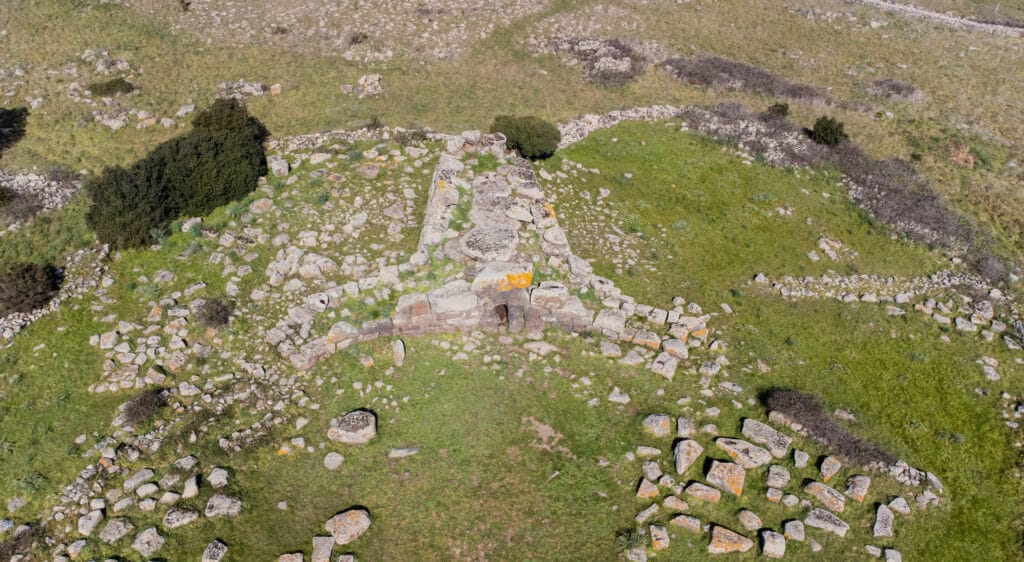
⭐ Paule Luturru – Samugheo (OR)
This tomb, which I visited during the recent January days with the low winter sun highlighting the pink trachyte of the orthostats, surprised me above all for one reason: 46 fragments of Copper Age statue-menhirs (3000–2500 BC) reused as building material. The Nuragic builders literally incorporated the sacred stones of a previous world into the foundations of the new one. Furthermore, the Sa Paule spring nearby adds yet another layer of sacredness to the site. Link to the dedicated article

⭐ Su Mont’e S’Abe – Olbia (SS)
In Gallura, not far from Olbia, this tomb offers one of the most complete experiences for anyone wanting to understand Nuragic funerary architecture. Its panoramic position and state of preservation make it particularly photogenic — so it is worth the journey for that alone. Link to the dedicated article

⭐ Barrancu Mannu – Santadi (SU)
Also known as “Sa Tuerredda”, this tomb presents the classic floor plan of Giants’ Tombs in a landscape of great beauty in the Sulcis region. Despite being located in an area less frequented by tourists, it is absolutely worth the detour. Furthermore, the late afternoon light in this corner of Sardinia is truly extraordinary for photography. Link to the dedicated article
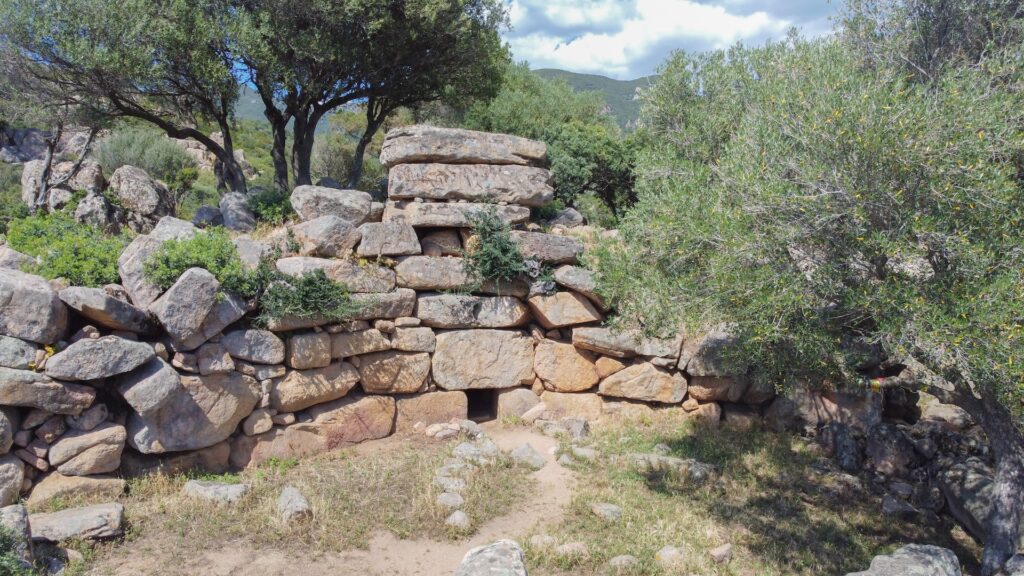
⭐ Madau – Fonni (NU)
In the heart of the Barbagia, in Fonni, the Madau tombs stand in mountain territory that in winter offers almost Nordic landscapes. Visiting them under snow or low-lying fog is therefore an experience you will not easily forget. Link to the dedicated article

🌊 Monte Pranu – The Discovery I Will Never Forget
There is a story connected to the Giants’ Tombs that still moves me every time I tell it. It involves Monte Pranu in the Sulcis region, and it began with a rumour picked up while exploring the territory: it was said that in the artificial lake created by the dam built between 1947 and 1951, several Giants’ Tombs and nuraghi lay submerged, swallowed by the water when the reservoir was filled. No official database listed them. No map pinpointed them with any precision. So I decided to go and look for them myself.
🔎 The First Expedition – Late June
The first time I went was in late June, taking advantage of the severe drought that had hit Sardinia the previous summer. Google Maps directions were imprecise and I spent a long time before finding the right spot, pushing through Mediterranean scrubland on unmapped trails in the blazing heat. Yet the effort was immediately rewarded: from the dry lakeshore I caught sight of the first tomb — the largest — still partially covered by water. A stone exedra emerging from the mud as if it were breathing. I stood there for a long time staring at it, unable to believe my eyes.

🔎 The Second Expedition – Mid-August
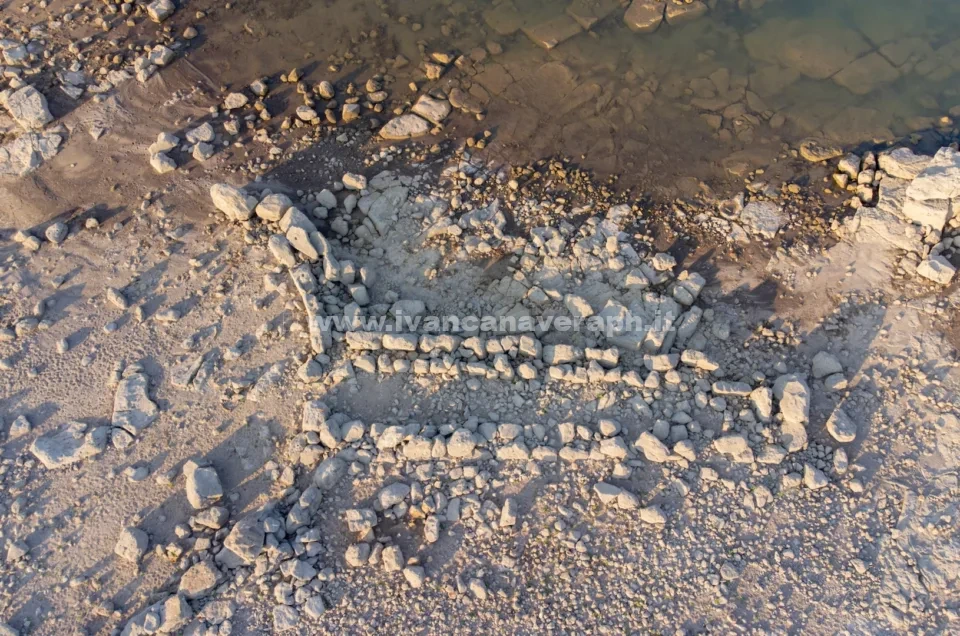
I returned in mid-August, when the lake level had dropped even further. This time I also had the drone with me. While flying I noticed nothing new, so I went home convinced I had photographed everything. Then, downloading the images onto the computer and studying them calmly from above, I saw something that had completely escaped me on the ground: three smaller structures, clearly recognisable as exedras of Giants’ Tombs, emerging a short distance away. No one had ever documented them. No one knew of their existence. Alongside these, the ruins of what appears to be a Nuragic village were also clearly visible, with the floor plans of rectangular huts surprisingly well defined from the air.

🔎 The Third Expedition – August Again
Despite the tremendous heat — full summer in the Sulcis, with temperatures that make every walk on foot a feat — I returned a third time to photograph the two smaller tombs from the ground as well. I walked for over an hour through the scrubland, on non-existent trails, under the midday sun. But when I finally reached them and stood before those stones emerging from the low water of the lake, the fatigue vanished instantly.
In total, in the Monte Pranu lake area I identified four Giants’ Tombs — whereas officially only one was recorded — plus an adjacent Nuragic village. I reported the discovery to the relevant Superintendency, attaching all the photographic and cartographic documentation I had collected.
An important note: in 2026 it will not be possible to see any of this. The abundant winter rains have brought the lake back to full capacity, and the tombs now lie at least 7–8 metres underwater. Therefore, you will need to wait for another particularly dry summer for them to resurface. Sardinia still holds many secrets — you just need the patience and determination to seek them out. Full article here

💡 Curiosity: The Small Door of the Stele
Have you ever noticed that small hole at the base of the arched stele? It is one of the things that has intrigued me most since my first visits. Archaeologists interpret this opening as a symbolic passage: too small to allow an adult body through, it was probably intended for the passage of the deceased’s soul, or perhaps used to deposit ritual offerings during ceremonies held after the burial.
It is therefore not a door for the living, but a threshold between two worlds: that of the living and that of the ancestors. A tiny detail that tells us a great deal about how the Nuragic people conceived of death and the journey into the afterlife.
🗺️ How to Organise a Tour by Region
The Giants’ Tombs are distributed throughout Sardinia, so the ideal approach is to group them by geographic area. Here is a suggested framework:
Northern Sardinia (Gallura): Coddu Ecchju and Li Lolghi in Arzachena, Su Mont’e S’Abe in Olbia, Pascaredda in Calangianus. An excellent area for combining archaeology with sea.
Central Sardinia (Barbagia and Mandrolisai): S’Ena e Thomes in Dorgali, Madau in Fonni, Paule Luturru in Samugheo, Iloi in Sedilo, Is Lapideddas in Gonnosnò. Mountain areas: warm layered clothing is essential in winter.
Southern Sardinia (Campidano and Sulcis): San Cosimo in Gonnosfanadiga, Sa Domu ‘e S’Orcu in Siddi, Barrancu Mannu in Santadi, Su Niu de Su Crobu in Sant’Antioco, Monte Pranu in Villaperuccio (visible only in dry summers). Flat and comfortable areas to reach by car.
The Giants’ Tombs are among the most important monuments in Sardinia, dating back around 3,000 years and found across the island. Here is a list of some of these tombs:
- – Giants’ Tomb of Lu Brandali, Santa Teresa Gallura (SS)
- – Giants’ Tomb of Iloi, Sedilo (OR)
- – Giants’ Tomb Is Lapideddas, Gonnosno (OR)
- – Giants’ Tomb of Aiodda, Nurallao (SU)
- – Giants’ Tomb of Barrancu Mannu, Santadi (SU)
- – Giants’ Tomb of Bau e Tuvulu, Ulassai (NU)
- – Giants’ Tomb of Biristeddi, Dorgali (NU)
- – Giants’ Tomb of Bruncu Espis, Arbus (SU)
- – Giants’ Tombs of Goronna, Paulilatino (OR)
- – Giants’ Tomb of Imbertighe, Borore (NU)
- – Giants’ Tomb of Is Concias, Quartucciu (CA)
- – Giants’ Tomb of Laccaneddu, Villanova Monteleone (SS)
- – Giants’ Tomb of Lassia, Birori (NU)
- – Giants’ Tomb of Coddu Ecchju, Arzachena (SS)
- – Giants’ Tomb of Li Lolghi, Arzachena (SS)
- – Giants’ Tomb Su Niu de Su Crobu, Sant’Antioco (SU)
- – Giants’ Tomb of Madau, Fonni (NU)
- – Giants’ Tomb of Muraguada, Bauladu (OR)
- – Giants’ Tomb of Oratanda, Cuglieri (OR)
- – Giants’ Tomb of Oridda, Sennori (SS)
- – Giants’ Tomb of Osono, Triei (NU)
- – Giants’ Tomb of Palatu, Birori (NU)
- – Giants’ Tomb of Pascaredda, Calangianus (SS)
- – Giants’ Tomb of Sa Dom’e s’Orcu, Dolianova (SU)
- – Giants’ Tomb of Sa Domu ‘e S’Orcu, Siddi (SU)
- – Giants’ Tomb of S’Ena e Thomes, Dorgali (NU)
- – Giants’ Tomb of Sa Farch’e s’Artare, Seneghe (OR)
- – Giants’ Tomb of Sa Perda ‘e S’Altare, Birori (NU)
- – Giants’ Tomb of San Cosimo, Gonnosfanadiga (SU)
- – Giants’ Tomb of Santu Bainzu, Borore (NU)
- – Giants’ Tomb of Sas Presones, Cuglieri (OR)
- – Giants’ Tomb of Su cuaddu ‘e Nixias, Lunamatrona (SU)
- – Giants’ Tomb of Su Mont’e S’Abe, Olbia (SS)
- – Giants’ Tombs of Sa Mandara, Guasila (SU)
- – Giants’ Tombs of Monte Pranu, Villaperuccio (SU)
- – Giants’ Tomb of Paule Luturru, Samugheo (OR)
- – Megalithic Tomb of Pranu Ciara, Suelli (CA)
- – Giants’ Tomb Perda Cossu, Norbello (OR)
- – Giants’ Tomb Cuccuru Mannu, Riola Sardo (OR)
- – Giants’ Tomb Sa Sedda e sa Caudela, Collinas (SU)
If you like these images, you can purchase them clicking HERE or HERE.
❓ FAQ in English
1. What exactly are the Giants’ Tombs? The Giants’ Tombs are collective burial monuments built by the Nuragic civilisation in Sardinia between approximately 1800 and 1100 BC. In the Sardinian language they are called tumbas de sos mannos (“tombs of the great ones”). The popular name comes from the imagination of shepherds who attributed these enormous structures to supernatural giants.
2. How many Giants’ Tombs exist in Sardinia? Over 800 monuments of this type have been recorded across the island, distributed throughout all provinces. Some are exceptionally well preserved, others reduced to just a few remains. Sardinia therefore represents the world’s largest concentration of these megalithic funerary monuments. New ones can still be discovered today, as demonstrated by the submerged tombs in Lake Monte Pranu.
3. What does the semicircular shape (exedra) of the tombs mean? Interpretations vary. The most academically accepted one sees in the exedra the shape of a bull’s head (taurine protome), a symbol of strength and fertility in Bronze Age Mediterranean cultures. There are also interpretations that read it as a representation of the feminine womb in reference to the cult of the Mother Goddess, or — less credibly — as the outline of a bow and arrow.
4. Can you enter the Giants’ Tombs? Most tombs are freely accessible without tickets or closing times. However, it is always necessary to respect the sites: do not touch the structures, do not move stones, do not climb. Some tombs are located on private land and require passing through gates that must always be closed behind you.
5. What is the best time of year to visit them? The tombs can be visited year-round. In summer you enjoy the best weather but the sites are more crowded. Spring and autumn offer optimal light for photography. Winter, despite the cold and humidity, provides extraordinary atmospheres and completely deserted sites. For the submerged tombs of Monte Pranu, you need to wait for summer drought conditions (late June–September), and only in years of pronounced water scarcity.


You might also like